Pecuniary liabilities and debt
David CopperfieldPecuniary liabilities and debt in David Copperfield are not merely recurring financial embarrassments: they govern where people can live, how families survive, who is imprisoned, and what one person may demand of another. The Micawbers’ changing fortunes make debt at once a source of comic performance and real deprivation, while the contrast between their insolvency and Uriah Heep’s financial wrongdoing exposes the difference between being unable to pay and using another person’s dependence for advantage.
Debt as Household Pressure
For the Micawber family, debt enters ordinary domestic life through creditors at the door, an empty larder, and the need to turn possessions into food and cash. Mrs. Micawber describes creditors who will not grant her husband time and argues that no payment can be extracted from a person who has nothing to give. The household’s public sign advertises a boarding establishment for young ladies, but no pupils appear; creditors are its actual visitors. Their demands follow Mr. Micawber into the home, where one creditor calls up the stairs and threatens him with public disgrace. Financial pressure thus becomes a daily intrusion into family privacy and respectability.
The family’s efforts to manage scarcity are practical, improvised, and precarious. David, still a child, lives with the Micawbers while working at Murdstone and Grinby’s. He buys his own small breakfasts and keeps bread and cheese for supper, supporting himself through the week on six or seven shillings. He recalls having no adult counsel or assistance to rely on. When Mrs. Micawber says there is nothing to eat, David offers her the two or three shillings he has left from his week’s money. She refuses the cash but asks him to help sell the family’s belongings instead. He carries Mr. Micawber’s books to a bookstall and also becomes familiar with pawning. The sales raise money for immediate needs, but they do not resolve the underlying insolvency; the small suppers that follow are relief purchased by the continued depletion of household possessions.
Arrest, Prison, and Insolvency
When Mr. Micawber’s difficulties reach a crisis, he is arrested in the morning and taken to the King's Bench Prison. His dramatic language presents the arrest as a collapse, yet David’s recollection also records the incongruity of hearing that Mr. Micawber played skittles before noon. The shift between despair and renewed activity belongs to the character’s way of enduring adversity; it does not make the arrest or the family’s financial condition imaginary.
David visits him on the first Sunday after his imprisonment. They meet inside the gate, go to Mr. Micawber’s room near the top of the building, and weep together. Mr. Micawber then offers David a rule of household arithmetic: spending slightly less than one’s income brings happiness, while spending even a little more brings misery. The advice condenses the novel’s recurring account of debt into a simple imbalance between means and expenditure. Its force is heightened by its setting: the lesson comes from a debtor who has borrowed a shilling from David for porter and written an order for repayment to Mrs. Micawber.
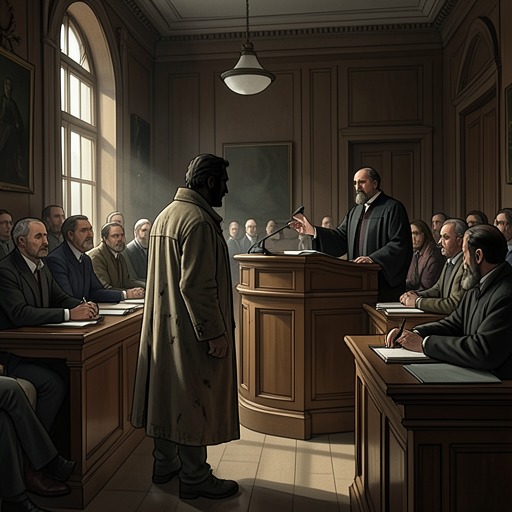
Mr. Micawber petitions for release under the Insolvent Debtors Act. His creditors are not represented as uniformly vindictive: even the boot-maker who had publicly demanded payment says in court that he bears no malice, while still wanting the money owed to him. The petition succeeds, although fees and formalities delay Mr. Micawber’s actual departure from prison. His case therefore presents insolvency as a legal condition with procedures and consequences, rather than as a simple contest between a blameless debtor and cruel creditors. Release ends this imprisonment, but it does not remove the habits, obligations, or financial vulnerabilities that will recur later.
Credit, Dependence, and Moral Obligation
The novel also follows debt beyond the Micawbers’ first imprisonment. Mr. Micawber later writes to David in the legal language he uses at moments of crisis, announcing that he has been crushed by his circumstances. When David and his companions encounter him again at the King's Bench, Mr. Micawber recalls the prison as a place where he had once lived without the daily calls of creditors at his door. His reminiscence makes the institution an unhappy refuge from a different form of pressure: confinement, at least, had brought a temporary end to creditors’ demands at home.
His later employment by Uriah Heep gives that dependence a more dangerous shape. Mrs. Micawber appeals to Thomas Traddles because she fears her husband’s changed conduct and the secrecy that has replaced his former openness with his family. Mr. Micawber explains that his salary is only twenty-two shillings and sixpence a week, while additional advances from Heep become necessary to support his wife and children. Those advances are secured by IOUs. In his account, Heep anticipated that necessity and used the resulting dependence to draw Mr. Micawber into a web of obligation. The debt is not simply an unpaid balance: it gives an employer leverage over a poorly paid employee and helps conceal Heep’s manipulation of the business.
Mr. Micawber eventually turns his position into an opportunity to investigate and expose Heep’s major frauds against Mr. Wickfield. He describes a prolonged, clandestine inquiry lasting more than twelve months and acknowledges that he had previously consented to lesser falsifications. His financial vulnerability helps explain how he became entangled, but it does not erase his responsibility for that earlier complicity. The decisive change comes when the pressure between a stipend and the family’s survival no longer outweighs his resolve to disclose Heep’s wrongdoing. Debt here marks both a means of control and a moral test: dependence can constrain action, but the narrative still distinguishes constraint from the choices made within it.
Settlement and the Ethics of Repayment
Other episodes show that a financial obligation can carry an ethical weight beyond its legal enforceability. Before leaving London, Mr. Micawber insists on acknowledging what he owes Thomas Traddles, who had twice put his name to bills to accommodate him. The first obligation had left Traddles in the lurch; the second had not yet fallen due. Mr. Micawber checks his records, calculates the combined amount as forty-one pounds, ten, and eleven and a half, and gives Traddles an IOU. The document is not the same as immediate repayment, but Mr. Micawber presents acknowledging the debt as necessary to recover his moral dignity. His formal language makes the scene comic, while the underlying concern—that a friend should not bear the cost of his accommodation—remains serious.
When Mr. Micawber later helps reveal Heep’s schemes, the outstanding advances still require attention. Traddles points out that Mr. Micawber’s IOUs may expose him to repeated arrest or execution, and that his own ledger puts the claims at 103 pounds, five. David and Traddles recommend paying the claims as they arise, providing the family’s passage and outfit, and giving them one hundred pounds. David also proposes entrusting Mr. Peggotty with discretion to advance another hundred pounds. The plan combines relief with an expectation that Mr. Micawber remain answerable for his advances; assistance is not treated as proof that obligations do not matter.
Across these episodes, debt moves between household emergency, legal confinement, personal guarantee, and a tool of commercial fraud. The Micawbers’ borrowing and Mr. Micawber’s prison experiences expose the instability of a family living beyond its means; David’s childhood earnings and small loans show how that instability can reach a child with few supports. The later conflict with Heep sharpens the distinction between honest insolvency and engineered dependence, while the arrangements for the Micawbers’ departure join generosity to accountability. Financial obligation is therefore both material and relational: it can impoverish and isolate, bind one person to another, or become the ground on which trust and responsibility are tested.